Historical sites in Denver
Castles, ruins, monuments and old quarters where the past is still standing.
-

1.Colorado National Guard Armory
The Colorado National Guard Armory, known commonly by locals simply as the Armory, is a landmark in Golden, Colorado. Unusual in its construction, it was at one time the largest cobblestone building in the United States. It was built in 1913 by the Colorado National Guard as an armory, quarters, mess hall and auditorium for the Guard's Company A of Engineers. When it was completed in 1914, the Company was housed in this building's second and third floors while the first-story garden level was available for rental to the public. The Armory's original uses included: Golden's Post Office ; photo shop ; barracks, mess hall, weapons storage and drill hall ; auditorium ; and map room (tower). Its engineering company served with distinction and under fire in France in World War I and remained in service here. In subsequent years the building served in part or whole as a hotel, offices, industrial bank, and student housing. During the influenza epidemic of 1918 the building became an emergency hospital for ill patients used by the Red Cross, and in 1933 it became the local headquarters of the Civil Works Administration, the federal depression era agency which created several area improvements. Armory Hall was open to the public and served the community for social gatherings, fundraisers, sports, and was the early home of Golden's American Legion post. Calvary Episcopal Church is the current property owner.
-
2.Martin Luther King Jr. Memorial
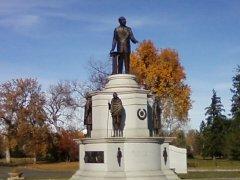
I Have a Dream is a statue of Martin Luther King Jr. and others by Ed Dwight, installed in Denver's City Park, in the U.S. state of Colorado. The memorial was installed in 2002, replacing another statue of King that was relocated to Pueblo. The Denver statue also features depictions of Frederick Douglass, Mahatma Gandhi, Rosa Parks, and Sojourner Truth.
-

3.Gully Homestead
The Gully Homestead is a former homestead located at 200 S. Chambers Road in Aurora, Colorado, United States.
-

4.Eastlake Farmers Co-Operative Elevator Company
The Eastlake Farmers Co-Operative Elevator Company is a grain elevator in Thornton, Colorado. The building was built in 1920, and is currently vacant. The elevator is an excellent example of a timber-frame, rural grain elevator that stands in stark contrast to the encroaching suburbs around the area.
-

5.Bradford House II
Bradford House II is a prehistoric rockshelter, 24 kilometres (15 mi) southwest of Denver. It is situated on land owned by the Ken-Caryl Ranch Master Association. It was excavated in the summer and fall of 1973 by the Denver Chapter of the Colorado Archaeological Society. The excavations found several cultural features and recovered thousands of chipped stone artifacts, dozens of ground stone artifacts, a few ceramic sherds, bone tools, and faunal remains. The site was used by prehistoric groups during the Middle and Late Archaic periods, as well as the Early Woodland, and Middle Woodland periods. This is a span of 4,500 years. Bradford House II is located in the Ken-Caryl Valley. The Front Range foothills to the west and the Lyons and Dakota hogbacks to the east frame the valley. An abundance of archaeological sites, attests to the valley's attraction for the earliest inhabitants of the area. They frequented the area for its abundant resources, including shelter under the many bedrock monoliths scattered across the valley, lithic materials for chipped stone tools, and edible plants and animals. West of the valley, the arkosic sandstones of the Pennsylvanian Fountain formation lie unconformably upon uplifted Precambrian metamorphic rocks of the Front Range. Although mostly covered by recent to pre-Wisconsin alluvium, the Fountain formation forms southwest facing escarpments, or monoliths, with undercut shelters or caves, many of which were inhabited by prehistoric peoples. The elevation of the site is approximately 1878 m (6160 ft.) above mean sea level. Elevations surrounding the site range from about 1828 m (6000 ft.) in the Dutch Creek water gap to 1992 m (6536 ft.) on the highest point of the Dakota hogback ridge. The valley has a sunny, mild, and semiarid climate that has neither the extreme cold of the higher elevations to the west nor the hot summer afternoons of the eastern plains. A south-facing rock shelter like Bradford House II absorbs a great deal of solar radiation, further mitigating the winter cold. Precipitation is moderate, averaging 15 to 18 inches, and winter snows melt quickly with frequent down slope (chinook) winds. The valley consists of various grasses and forbs. The surrounding hogbacks and foothills support a pine-Douglas fir vegetation community. The recovery of floral materials from Bradford House II and other archaeological sites in the valley indicates that local plants such as sunflower, wild plum, acorn, and chokecherry were gathered and used by prehistoric peoples. Many animals, including elk, mule deer, and occasional Big Horn sheep, as well as a variety of carnivores, rabbits, rodents, birds, amphibians, reptiles, and fish are found in the hogbacks and foothills. Unworked animal, mostly mammal, bone was found in abundance in the Archaic and Early Ceramic levels. Mule deer dominates the assemblage, followed by elk, bison, and rabbit, with little change in dietary preferences from the earlier to later time periods. Several bone tools and antler flakers were recovered from all cultural levels in the site.
-

6.Colorado Amphitheater
The Colorado Amphitheater (Zypher Amphitheater), also known as Structure #41, is a natural stone amphitheater built in 1935 to serve Camp George West of the Colorado National Guard. It is located near the base of South Table Mountain, a mesa located just east of Golden, Colorado.
-

7.Civil War Monument
The Civil War Monument is a statue of a Civil War cavalryman by Jack Howland that was originally installed outside the Colorado State Capitol in Denver. The memorial is also known as the Civil War Memorial, Soldier's Monument, and Civil War Soldier. The work was dedicated on July 24, 1909, after being cast by the Bureau Brothers.
-

8.LoDaisKa site
The LoDaisKa Site is a prominent archaeological site in the U.S. state of Colorado, located within a rockshelter near Morrison. The rockshelter was first inhabited by people of the Archaic through the Middle Ceramic period, generally spanning 3000 BC to 1000 AD.
Book your trip
Ready for Denver?
Compare flights, hotels and tours — straight to our partners.
Affiliate links — we earn a small commission at no extra cost to you.