Historical sites in Atlanta
Castles, ruins, monuments and old quarters where the past is still standing.
-

1.Margaret Mitchell House
The Margaret Mitchell House is a historic house museum located in Atlanta, Georgia. The structure was the home of author Margaret Mitchell in the early 20th century. It is located in Midtown, at 979 Crescent Avenue. Constructed by Cornelius J. Sheehan as a single-family residence in a then-fashionable section of residential Peachtree Street, the building's original address was 806 Peachtree Street. The house was known as the Crescent Apartments when Mitchell and her husband lived in Apt. 1 on the ground floor from 1925 to 1932. While living there, Mitchell wrote the bulk of her Pulitzer Prize-winning 1936 novel, Gone with the Wind.
-

2.Rhodes Hall
Rhodes Memorial Hall, commonly known as Rhodes Hall, is a historic house located in Atlanta, Georgia, United States. It was built as the home of furniture magnate Amos Giles Rhodes, proprietor of Atlanta-based Rhodes Furniture. The Romanesque Revival house occupies a prominent location on Peachtree Street, the main street of Atlanta, and is listed in the National Register of Historic Places. It is open to the public and has been the home of The Georgia Trust for Historic Preservation since 1983.
-

3.First United Methodist Church of Atlanta
The Atlanta First United Methodist Church has existed for more than 160 years and is one of the oldest churches in Atlanta. The current building was constructed in 1903, and the current name was adopted in 1968. The same bell has been used in three buildings since 1850, and it is the only church bell in Atlanta that is known to have survived the American Civil War. It was added to the National Register of Historic Places in 2010.
-

4.The Commons At Imperial Hotel
The Imperial Hotel in Atlanta is one of the few remaining tall buildings from the city's construction boom in the early 20th century. The former hotel was opened in 1910, has 8 stories, and is representative of the Chicago school due to the flat roof and brick facade with grids of bay windows. It contains two historic Otis elevators. It was abandoned in 1980, added to the National Register of Historic Places a few years later, eventually converted to low-income housing, and is undergoing another round of renovations as of 2012.
-

5.The Wimbish House
The Wimbish House is a historic building in Atlanta, Georgia, United States, commissioned in 1898 and finished in 1906. It has been owned and operated by The Atlanta Woman's Club since they purchased it in 1920. The idea for the house came from Mrs. Susie Lenora Wimbish, after being inspired by the châteauesque style homes she saw in the south of France. It was designed by architect Walter T. Downing. It was listed on the National Register of Historic Places in 1979 as "Atlanta Women's Club Complex". The complex is listed as being in three parts: the Clubhouse, Banquet Hall and the Auditorium.
-

6.Garnett Station Place
Garnett Station Place, also known as the Southern Belting Company Building and the Toshiba Building, is a historic building on Forsyth Street in downtown Atlanta, Georgia. It was designed by the firm of Lockwood Greene and Company and completed in 1915. In 1985 the architectural firm Stang and Newdow were retained to renovate the building into loft office space. In August 1988 the building was added the National Register of Historic Places.
-

7.Hope Moving Forward
Hope Moving Forward is a public monument in Atlanta, Georgia, United States. Dedicated in 2021, the monument consists of a bronze statue of Martin Luther King Jr. designed by Basil Watson atop a pedestal. It is located at the intersection of Northside Drive and Martin Luther King Jr. Drive.
-
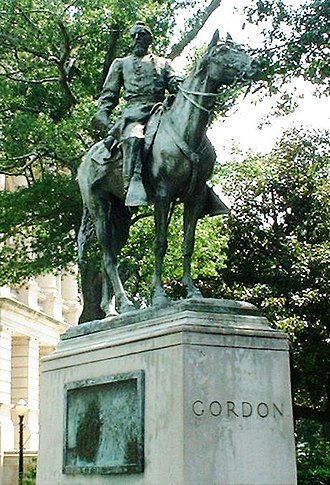
8.John Brown Gordon
The equestrian statue of John Brown Gordon is a monument on the grounds of the Georgia State Capitol in Atlanta, Georgia, United States. The monument, an equestrian statue, honors John Brown Gordon, a general in the Confederate States Army during the American Civil War who later become a politician in post-Reconstruction era Georgia. Designed by Solon Borglum, the statue was dedicated in 1907 to large fanfare. The statue has recently become a figure of controversy over Gordon's racist views and associations with the Confederacy, with some calling for its removal.
Book your trip
Ready for Atlanta?
Compare flights, hotels and tours — straight to our partners.
Affiliate links — we earn a small commission at no extra cost to you.